Auctions suit jewelry because they create visible price discovery. Instead of accepting a fixed retail price, buyers can evaluate a piece, observe competing interest, and decide what it is worth to them. The format also brings together one-of-a-kind vintage pieces, estate jewelry, new styles, and collectibles that may be difficult to find in a conventional store.
At Jewelry and More Auctions, collectors, resellers, and individual shoppers can review item details, watch lots, and place bids in a transparent online environment. The current selection includes jewelry, brooches, rings, necklaces, commemorative coins, and household items.
How to evaluate diamond jewelry auction lots
A diamond jewelry auction requires more than a quick glance at the stone’s sparkle. Begin with the four primary grading factors: carat, color, clarity, and cut.
Carat
Carat refers to a diamond’s weight, not its visible size. Larger stones are generally more valuable, but carat weight should never be considered alone. Two diamonds with the same carat weight can differ substantially in appearance and price because of their cut, color, clarity, and shape.
Pay attention to whether the listed carat weight applies to one center stone, multiple stones, or the total diamond weight of the piece.
Color
For white diamonds, color grades typically range from colorless to visibly tinted. A colorless stone may appear brighter in certain settings, while a warmer diamond can still offer attractive character and value.
For fancy-color diamonds, confirm whether the color is natural, treated, or created through laboratory methods. The description should provide this information when known.
Clarity
Clarity describes the presence of internal inclusions and surface blemishes. A lower clarity grade does not automatically make a diamond unattractive. Some inclusions are difficult to see without magnification, while others may affect brilliance or durability.
When reviewing a lot, look for clarity information, close-up images, and any condition notes. If the stone is large or the jewelry is intended for daily wear, inclusions near the girdle or surface deserve particular attention.
Cut
Cut influences how effectively a diamond reflects light. Proportions, symmetry, polish, and facet arrangement all affect brightness and fire. Older jewelry may contain Old European, Old Mine, or transitional cuts. These stones often have broader facets and a different visual character from modern brilliant cuts.
Do not assume that an antique diamond should be judged by modern-cut standards. Compare it with similar period jewelry instead.

Certificates, provenance, and setting condition
For a higher-value diamond jewelry auction lot, check whether a laboratory report accompanies the stone. A report can confirm the diamond’s measurements, grading characteristics, treatments, and, in some cases, whether it is natural or laboratory-grown.
Read the language carefully:
- Natural diamond: Formed through geological processes.
- Lab-grown diamond: Created in a controlled laboratory environment but composed of crystallized carbon with diamond properties.
- Simulant: A different material designed to resemble diamond, such as cubic zirconia or synthetic moissanite.
These categories have different market values. A clear description helps buyers compare like with like.
The mounting also matters. Examine the prongs, bezels, clasps, hinges, and shanks for visible wear or damage. Loose prongs can place a stone at risk. A ring may also need resizing, and some designs have limited resizing potential. For resellers, repair costs should be included in the projected margin.
Finding value in vintage and antique jewelry
A vintage jewelry auction can reward careful observation. The most useful clues often appear in small details rather than in the overall impression of a piece.
Hallmarks and maker’s marks
Hallmarks identify metal fineness, manufacturer, origin, or period. Common marks include:
- 925: Sterling silver, generally 92.5% pure silver.
- 585: 14-karat gold, generally 58.5% pure gold.
- 750: 18-karat gold, generally 75% pure gold.
- PT950: Platinum, generally 95% pure platinum.
A maker’s mark can add collectible value, but it should be interpreted with care. Look for a clear, consistent mark and compare its placement and style with reliable reference material. Worn, incomplete, or altered marks should be disclosed in the lot description or condition report.
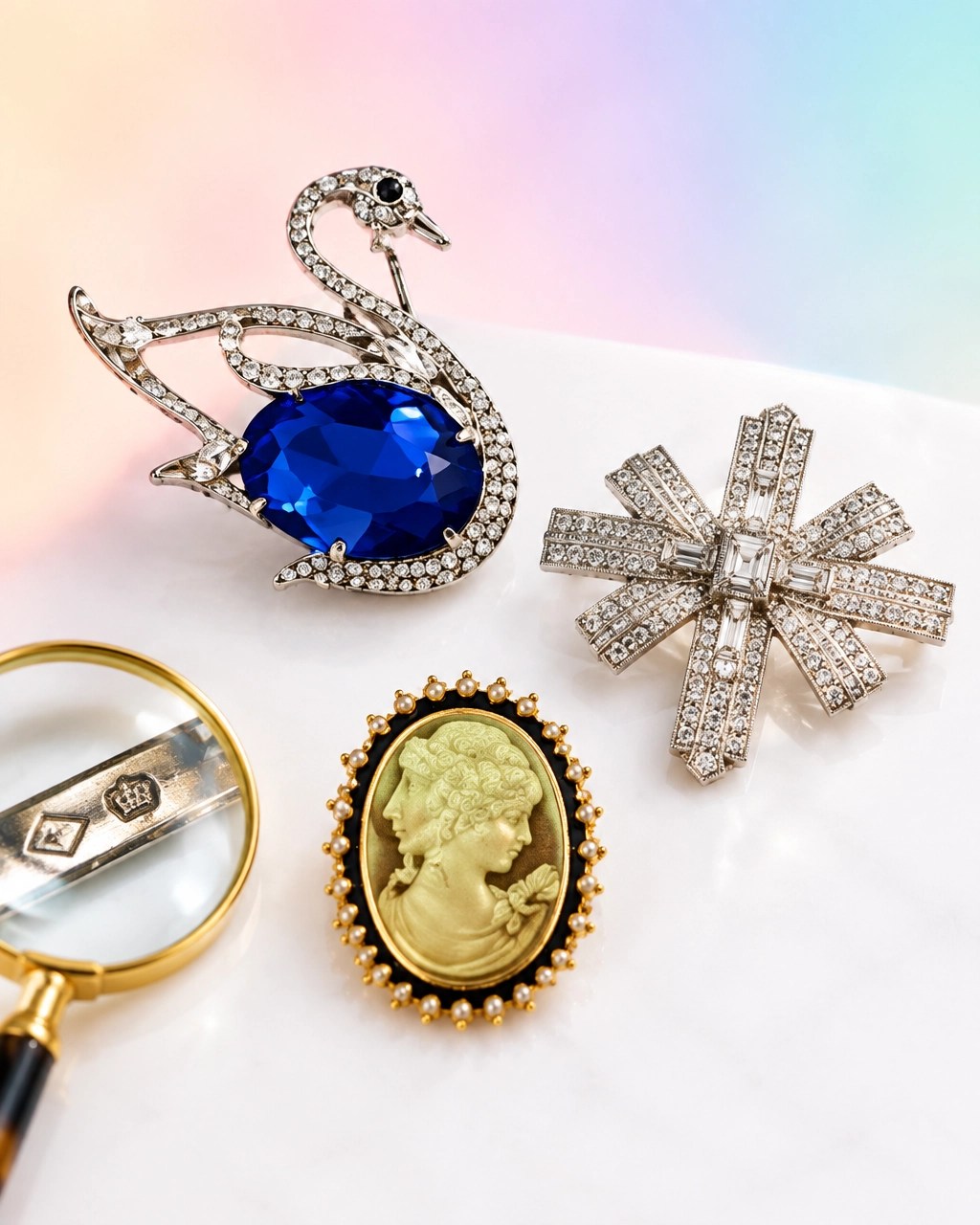
Jewelry and More Auctions offers examples such as a vintage sterling silver bracelet and a blue swan vintage brooch. These types of pieces show why design, construction, and condition matter alongside metal content.
Recognizing design periods
Style can help place a piece within a historical period:
- Art Deco: Geometric forms, symmetry, stepped patterns, and strong contrast.
- Victorian: Relief work, symbolic motifs, cameos, floral elements, and detailed metalwork.
- Edwardian: Delicate openwork, platinum settings, lace-like designs, and romantic motifs.
- Retro: Bold curves, sculptural forms, and larger visual proportions associated with the mid-20th century.
Style alone does not establish age. Construction techniques, metal marks, stone cuts, fasteners, and wear patterns should support the identification.
Originality versus replacement stones
Original stones and components may increase the collectible value of an antique piece. Replaced stones are not necessarily a defect, especially when the jewelry is intended to be worn. However, a replacement can affect historical integrity, matching, and resale value.
Review whether the lot notes:
- Replaced or synthetic stones
- Repaired or rebuilt settings
- Resizing or re-shanking
- Re-polishing
- Converted brooches or pendants
- Missing components
- Non-original clasps or findings
An honest condition description gives buyers a stronger basis for deciding whether a piece is suitable for collecting, wearing, or resale.
How to bid at auction with discipline
The best answer to “how to bid at auction” is simple: research first, budget second, click third.
Read the complete lot description. Confirm the material, measurements, size, stone type, condition, and included documentation. Do not rely on the headline or photograph alone.
Set an all-in budget. Include the winning bid, applicable taxes, and shipping. At Jewelry and More Auctions, auction orders ship for a $7 flat-rate fee regardless of the number of items purchased. Every order also includes a free gift. Include those terms in your planning before bidding.
Compare like with like. Compare a natural diamond with other natural diamonds, a lab-grown diamond with comparable lab-grown stones, and a marked sterling silver piece with similar silver jewelry. Do not compare unlike materials based only on size or appearance.
Watch the lot before bidding. Watching gives you time to observe the current bid, bidding activity, and any changes to the listing. It also helps prevent rushed decisions.
Write down your ceiling. Your maximum bid should reflect the item’s condition, your intended use, and your total budget. Once the bidding passes that ceiling, walk away. Another attractive lot will appear.
New bidders can review the company’s guide to live online auctions before participating. Registration, lot review, and budget planning are more important than complicated bidding tactics.

Understanding estate jewelry auction value
An estate jewelry auction may include pieces from prior owners, family collections, downsizing sales, or asset liquidations. The word “estate” describes the jewelry’s ownership history; it does not automatically indicate that every item is antique or rare.
Value may come from several sources:
- Documented ownership or notable provenance
- A recognizable maker or designer
- Precious metals and gemstones
- Period design
- Original condition
- Wearability and current styling
- Comparable auction results
Honest wear is part of estate jewelry. Surface marks, softened engraving, patina, and minor abrasions can show that a piece has been used. The important distinction is between acceptable wear and structural problems such as cracked stones, weakened prongs, broken hinges, or missing sections.
For resellers, calculate the cost of cleaning, repair, authentication, photography, platform fees, and shipping before deciding on a maximum bid.
Charity auction jewelry and the Bid to Give approach
Jewelry and More Auctions connects auction participation with charitable giving through its Bid to Give approach. Campaigns may support causes including Feed the Hungry, the American Cancer Society, The Elephant Sanctuary, and Meriwether Lewis County Memorial.
Beneficiary details can vary by campaign. Review the specific auction or campaign description to confirm the named organization, the allocation structure, and any relevant terms. This approach allows buyers to acquire jewelry, coins, and other goods while contributing to a defined charitable purpose.
The company also accepts consignments from individuals and organizations, creating opportunities for jewelry owners and asset holders to liquidate items through an auction format while supporting charitable campaigns where applicable.
Explore the fall selection
A well-prepared bidder does not need to win every lot. The objective is to identify pieces with clear descriptions, suitable condition, and a price that remains reasonable after all costs.
Review the live auctions for current jewelry, vintage finds, commemorative coins, and other available items. Visit the Jewelry and More Auctions homepage to learn more about the company’s auction and charitable mission.
Shipping reminder: Every auction order includes $7 flat-rate shipping regardless of the number of items purchased, plus a free gift with every order.
Top 10 Jewelry Pieces That Steal the Spotlight in Our Auctions