Set-building rewards planning more than impulse. The objective is not to own the most pieces in a patriotic coins auction. It is to identify the exact formats, finishes, condition standards, and price limits that make a collection complete without turning every bid into a bidding duel with your budget.
This week’s strategy applies to 2026 silver eagle coins, US Mint 250th anniversary coins, commemorative medals, and estate jewelry. Whether you collect, resell, or simply want to buy collectible coins online, use the same principle: define the set before you buy the first item.
The 2026 Silver Eagle set: what “complete” really means
The American Silver Eagle series began in 1986. The 2026 program marks its 40th anniversary, from 1986 through 2026, while also recognizing America’s 250th anniversary. The defining design features are the dual date 1776–2026 and the Liberty Bell privy mark containing 250.
These details make the 2026 issue more than another annual Silver Eagle. They create a one-year checkpoint that series collectors can identify immediately.

The three principal formats
Proof: The 2026-W Proof Silver Eagle is a collector issue struck at West Point. Its mirror-like fields and frosted design elements create the sharp contrast associated with proof coins. Current program information identifies a maximum mintage of 500,000 pieces.
Enhanced Uncirculated: The 2026-W Enhanced Uncirculated Silver Eagle uses specially treated surfaces that differ from both proof and standard uncirculated strikes. Its lower stated mintage cap of 125,000 pieces makes it particularly important to collectors pursuing every official finish.
Bullion: The bullion format is produced for the precious-metals market and distributed through authorized purchasers rather than sold in the same manner as a boxed Mint proof. Bullion Eagles generally do not carry a visible mint mark. For any auction lot, confirm the description, packaging, and identifying features rather than assuming that every 2026 coin has a “W.”
The dual date and Liberty Bell “250” privy mark are confirmed features on the proof and Enhanced Uncirculated issues. Auction listings for bullion should be reviewed carefully because distribution and catalog details can differ from the West Point collector products.
A practical definition of a complete 2026 set
For most collectors, a complete 2026 Silver Eagle set includes:
- One 2026-W Proof Silver Eagle.
- One 2026-W Enhanced Uncirculated Silver Eagle.
- One 2026 bullion Silver Eagle.
- Original Mint packaging and certificates where issued.
- A consistent condition standard across all three pieces.
Graded examples, special labels, signed holders, first-day designations, and multiple bullion sources are optional expansions, not requirements for the basic set. Decide this before bidding. Otherwise, “complete” can quietly expand from three coins to twelve variations while your wallet requests an adjournment.
For additional background, review the U.S. Mint’s 2026 coin program information and compare each auction description with the official specifications.
US Mint 250th anniversary coins: separate the categories
The United States Semiquincentennial program covers more than one coin series. The official program includes circulating coins with temporary designs, dual-dated issues, American Eagle products, modern Morgan and Peace dollars, and other collector releases. The U.S. Mint Semiquincentennial program is the best starting point for identifying official issues.
Dual-dated issues
The 1776–2026 date links a 2026 issue directly to the national anniversary. On selected collector coins, the Liberty Bell “250” privy mark reinforces that connection. These features may attract collectors who build by series, design element, or historical event.
One-year designs
The 2026 circulating program includes one-year-only designs on selected denominations, including special quarter, dime, and half-dollar treatments. One-year designs often receive significant attention at launch because collectors want an example before the design disappears from regular production.
After the first year, the market usually becomes more selective. Initial excitement may soften, leaving mintage, condition, packaging, and long-term collector demand to determine which pieces retain a premium. A first-year label alone does not guarantee rarity.
Official coins versus medals and replicas
This distinction matters in any American heritage collectibles auction:
- Official U.S. Mint coin: Identified by a denomination or face value, issuing authority, and legal-tender status.
- Official U.S. Mint medal: Produced by the Mint but generally does not carry a face value and is not legal tender.
- Private medal or challenge coin: Made by a private company, organization, military unit, or event sponsor. It may have historical or sentimental appeal but is not a U.S. Mint coin.
- Replica: A reproduction of an earlier design. It can be attractive and collectible, but it should not be valued as an original historical issue.
A clear lot description should tell you which category you are considering. If it does not, treat that uncertainty as a reason to lower your maximum bid, not as an invitation to guess.
How to value a commemorative piece
A theme creates interest. It does not automatically create rarity. Evaluate a commemorative coin, medal, or token in this order:
- Identity: Confirm the issuing authority, denomination, date, metal, weight, and fineness.
- Mintage: A low production figure may support a premium, but only if collectors want the item.
- Finish: Proof, enhanced, matte, and uncirculated finishes attract different buyers.
- Grade: Original surfaces, sharp details, and professional certification can materially affect value. Never clean the piece.
- Packaging: Original capsules, boxes, certificates, and Mint documentation help establish authenticity and preserve condition.
- Provenance: Receipts, original ownership records, or a documented collection history can increase confidence.
- Demand: Compare recent sales for the exact issue, finish, grade, and packaging status.
The practical formula is simple: establish a bullion or face-value floor, identify the evidence supporting a premium, then compare recent realized prices. Do not pay a rarity premium for an item that is merely patriotic, colorful, or marked “limited edition.” Many private products use scarcity language generously.
Estate jewelry: inspect the lot in the right order
An estate jewelry auction, vintage jewelry auction, or antique jewelry auction requires the same discipline as a coin purchase. Start with evidence, not atmosphere.
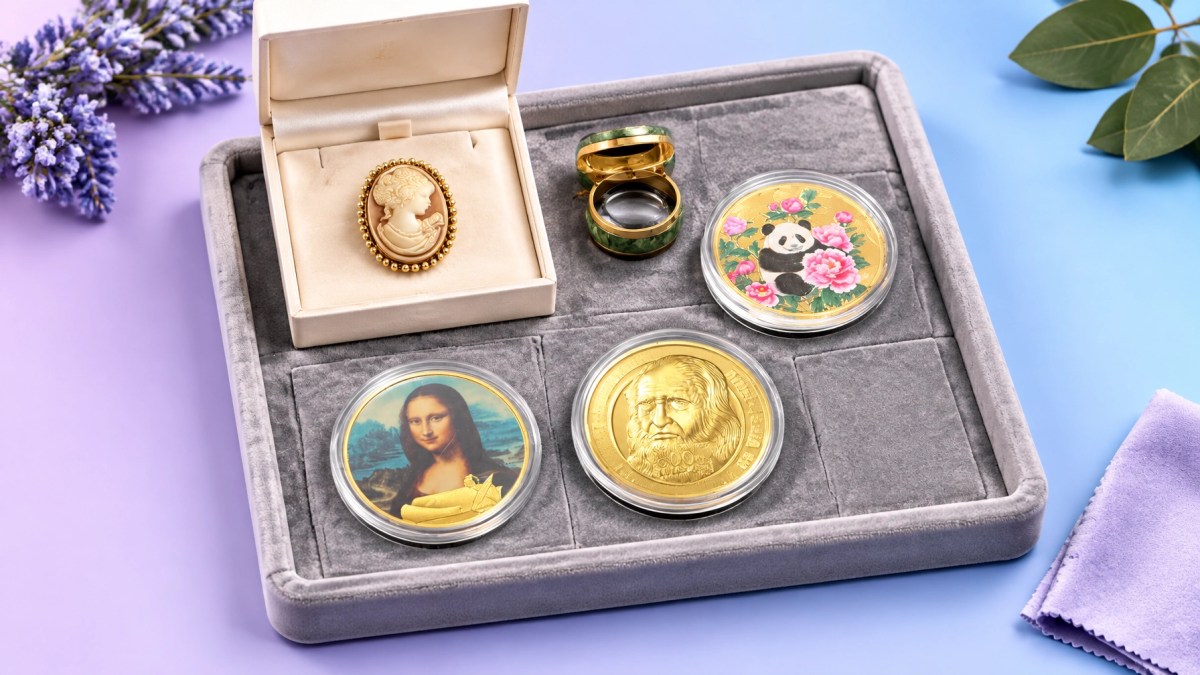
Rings
- Read the metal mark, such as 925, 585, 750, or PT.
- Check the band for thinning, resizing seams, flat spots, or distortion.
- Inspect prongs and bezels for looseness, replacement, or excessive wear.
- Look closely at stones for chips, abrasions, mismatched cuts, or cloudy areas.
- Confirm the ring size and whether the stone claims are documented.
A ring may look bright in a photograph while having a thin shank or worn prongs. Shine is not a structural report.
Brooches
- Examine the front for missing stones, enamel loss, and uneven wear.
- Turn it over and inspect the pin stem, hinge, catch, and solder joints.
- Look for a maker’s mark and metal hallmark on the main body, not only the clasp.
- Check whether the brooch has been converted into a pendant or altered.
- Compare the construction and wear with the stated period.
A period-style design is not proof of age. Construction details usually tell the more useful story.
Necklaces
- Inspect the chain for kinks, stretched links, repairs, or mismatched sections.
- Review the clasp closely and confirm whether it appears original.
- Check the pendant bail, stone settings, and connecting rings.
- Confirm the length, metal content, and weight where provided.
- Look for replacement components that may carry a different hallmark.
Request additional photographs or a condition report when the clasp, hallmark, or setting is unclear. Read the auction terms as carefully as the lot description, especially when items are sold as-is.
Three-minute pre-bid inspection
Use this short checklist before placing a bid:
- Minute one: View the front, back, profile, clasp, hinge, pin, and hallmark photographs.
- Minute two: Note metal, size, stones, finish, damage, repairs, missing components, and packaging.
- Minute three: Calculate your maximum all-in cost, including buyer’s premium, tax, and shipping. Confirm that the lot category matches your collecting goal.
This is the practical foundation of learning how to bid at auction. Beginners do not need to know everything. They need to know what must be verified before bidding.
The reseller advantage: shipping as a margin tool
Jewelry and More Auctions charges a $7 flat-rate shipping fee for all auctions, regardless of how many items are won. When multiple items are won, extra shipping is refunded. Every order also includes a free gift.
For resellers, this changes the calculation. A coin, a brooch, and a necklace can be grouped into one order rather than treated as separate shipping events.
| Items won | Total shipping | Effective shipping per item |
|---|---|---|
| 1 | $7.00 | $7.00 |
| 3 | $7.00 | $2.33 |
| 5 | $7.00 | $1.40 |
| 10 | $7.00 | $0.70 |
The sensible approach is to build a watch list across categories, then bid only where the item supports your resale or collection plan. Combining coins and jewelry can protect margin, but shipping savings should never justify buying an item with weak demand.
Build the set, then enter the auction
Use the live auctions at Jewelry and More Auctions to compare available coins, jewelry, commemorative pieces, and household items. Set your target format, condition, and maximum price before the auction begins.
For coin collecting for beginners, a three-piece 2026 Silver Eagle set is a manageable starting point. Experienced collectors can expand into packaging variants, certified grades, and related Semiquincentennial issues. Resellers can use the flat-rate shipping structure to combine suitable inventory into one shipment.
A disciplined coin auction online strategy is not about winning every lot. It is about recognizing the right lot, paying a defensible price, and leaving enough room for the next opportunity. Jewelry and More Auctions makes that process transparent through an auction format designed for collectors, resellers, and buyers who value both history and practical value.
Silver Wings: A Collector’s Guide to the 2026 Silver Eagle Coins