Resellers do not win auctions by chasing every shiny object. They win by recognizing demand, verifying condition, controlling acquisition costs, and understanding which details create a premium.
That approach matters in today’s market for 2026 silver eagle coins, semiquincentennial memorabilia, and estate jewelry. It also makes the right auction platform more valuable. At Jewelry and More Auctions, every auction order carries a $7 flat-rate shipping fee, regardless of how many items you purchase, and every order includes a free gift.
2026 Silver Eagle Coins: The Details Driving Demand
The headline release is the 2026-W American Eagle One Ounce Silver Proof Coin, struck at West Point. It contains one troy ounce of .999 fine silver and carries the familiar Walking Liberty obverse with a special 2026 treatment: the dual date “1776 ~ 2026” and a Liberty Bell privy mark featuring “250.”
The combination is significant because both design elements are tied to America’s semiquincentennial. The 2026-W proof has a published mintage limit of 500,000 and launched at a U.S. Mint issue price of $173. Available inventory sold out in approximately 17 minutes during the initial release. The Mint later resumed sales, demonstrating an important market lesson: a sell-out can create urgency, but a restock can temporarily change the premium.
The separate 2026-P Proof American Silver Eagle appeared in the Congratulations Set. It carries the Philadelphia “P” mintmark and is distinct from the West Point coin. Collectors should not assume that every 2026 Silver Eagle contains the dual date or the Liberty Bell privy. Read the listing carefully and verify the mintmark, finish, packaging, and design features.
Finishes and varieties collectors watch
For American Eagle collectors, finish is not a decorative footnote. It is part of the coin’s identity and market position.
- Proof: Mirror-like fields and frosted design elements. The 2026-W proof is the key anniversary release.
- Reverse proof: Frosted fields and mirror-like devices. Reverse proofs are often issued in limited sets or special products, so verify that a claimed 2026 reverse proof is a documented Mint issue rather than a vague seller description.
- Burnished or uncirculated: A softer, satin-like finish produced for collectors rather than ordinary circulation. The 2026 program also includes an enhanced uncirculated Silver Eagle tied to the anniversary design.
- Privy-marked issues: The Liberty Bell “250” mark is central to the 2026-W semiquincentennial issue. Special privy marks can create strong collector interest, but only when the mark is genuine and associated with an authenticated release.
Before bidding in a patriotic coins auction, compare the lot description with official specifications. Confirm whether the coin is raw or certified, whether original Mint packaging and the certificate of authenticity are included, and whether the photographed coin matches the stated mintmark.
Grading, condition, and premiums
A certified PF or PR grade describes a proof coin’s condition. A PF/PR-69 example typically has minor imperfections under magnification, while PF/PR-70 represents a coin that meets the grading service’s standard for a perfect grade. That one-point difference can produce a substantial price gap.
Do not pay a PF-70 premium simply because a listing uses words such as “perfect,” “first strike,” or “early release.” Those labels may describe packaging or submission timing, not superior preservation. Look for the grading company, certification number, label designation, and images of the actual slab.
For raw coins, inspect the fields for hairlines, haze, spots, fingerprints, and contact marks. Never clean a proof coin. A bright surface is not automatically a healthy surface; aggressive cleaning can reduce collector value.
The initial sell-out and later Mint restock also show why a coin auction online can be useful. Secondary-market supply may include original Mint packaging, certified examples, and coins acquired at different points in the release cycle. Bid from completed-market evidence, not release-day excitement.

The U.S. Mint 250th Anniversary and American Heritage Collectibles
The term semiquincentennial means a 250th anniversary. July 4, 2026 marks 250 years since the Declaration of Independence and the founding era of the United States.
The U.S. Mint’s 2026 program is historically notable because it introduces one-year-only designs across many circulating and collector issues. The coins use the dual date 1776 ~ 2026, the Liberty Bell “250” privy mark, and imagery connected to American liberty and civic development.
The circulating quarter designs reference major chapters in the national story, including the Mayflower Compact, the Revolutionary War, the Declaration of Independence, the Constitution, and the Gettysburg Address. That structure gives collectors more than a single commemorative object. It creates a narrative series.
Anniversary-year coins often attract lasting attention for three reasons:
- The historical date is easy to understand and remember.
- The designs are limited to a defined release period.
- Collectors build sets around the complete program rather than one isolated coin.
Demand in a patriotic coins auction tends to rise when the item combines a recognizable national theme, a low or controlled mintage, strong condition, and clear documentation. It does not rise simply because the word “anniversary” appears in a title. Mintage, authenticity, metal content, finish, and buyer demand still determine value.
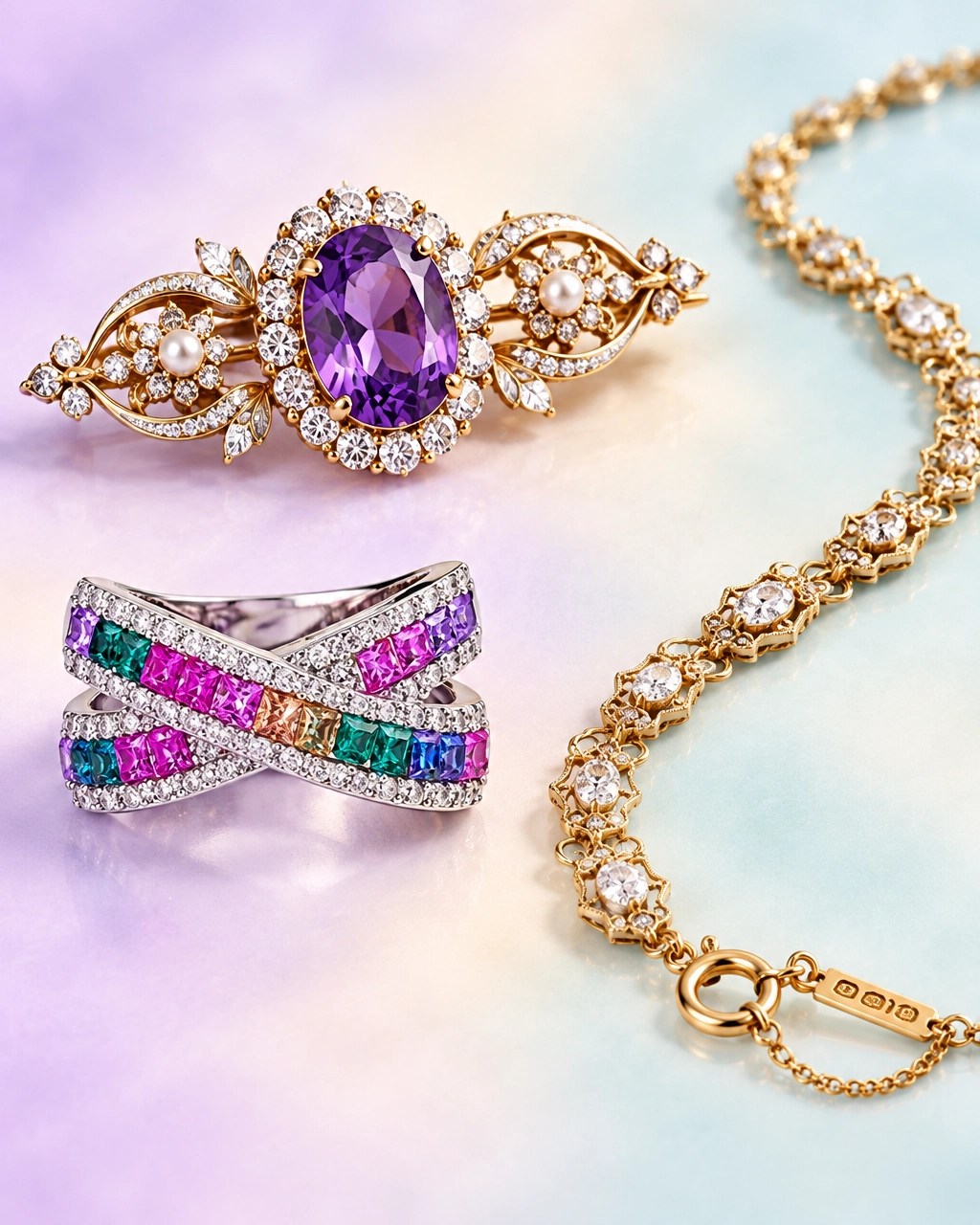
How to Spot High-Value Estate Jewelry at Auction
Estate jewelry means previously owned jewelry. It may be five years old, 50 years old, or more than a century old. The label alone does not establish age or value.
Start with marks
Use a 10× loupe to inspect:
- Ring shanks and the area beneath the center stone
- Necklace clasps and connecting links
- Brooch backs, hinges, and pin stems
- Pendant backs and hidden galleries
Common marks include 14K, 18K, 10K, 750, 585, 417, 925, STERLING, PT950, and PT900. “GF” generally means gold-filled, while “GP” indicates gold-plated material. These are not equivalent to solid gold.
A maker’s mark or signature can add significant value, but a name stamp is not proof of authenticity. Check the font, placement, serial number, construction quality, and period. A claimed luxury piece with crude soldering, an incorrect clasp, or inconsistent marks deserves caution.
Examine the setting and construction
Fine jewelry usually shows deliberate construction:
- Prongs sit evenly and hold stones securely.
- Bezels and channels fit the stones without visible gaps.
- Clasps close firmly without excessive play.
- Links lie flat and show limited stretching.
- Soldering is controlled rather than bulky or uneven.
Period details also matter. Victorian, Edwardian, Art Deco, Retro, and Mid-Century jewelry each have characteristic silhouettes, motifs, cuts, clasps, and manufacturing techniques. An old-style design with brand-new metal, modern findings, and inconsistent wear may be a later reproduction.
Evaluate stones without overpromising
At an auction preview, visual inspection is useful but not conclusive. Look for chips, abrasions, loose stones, cloudy areas, bubbles, or visible glue. Glue behind a stone often indicates costume jewelry or a low-cost repair.
Compare stones within the same piece. One stone that is noticeably whiter, cleaner, or differently cut may be a replacement. In antique jewelry, old mine or old European cuts may support the period; a modern brilliant cut may indicate a later replacement.
If the value depends on a significant diamond, sapphire, ruby, emerald, or other gemstone, treat an independent gemological report as stronger evidence than a promotional description. Factor testing, insurance, repair, and resale costs into your maximum bid.
Red flags that should lower your ceiling
Be cautious when you see:
- Shallow, uneven, or suspiciously restamped hallmarks
- Mismatched purity marks in a supposed matching set
- Thin shanks or links worn nearly to an edge
- Loose prongs, cracked metal, or heavy undocumented repairs
- Strong magnet reaction on a piece described as solid gold
- Modern components attached to an allegedly antique item
- A luxury signature unsupported by appropriate construction
A beautiful piece can still be a poor resale buy if repair costs consume the margin. In an estate jewelry auction, quality is the combination of materials, design, condition, authenticity, and demand.
The Reseller’s Margin Advantage: Simple Shipping Math
Shipping is a cost of goods. It belongs in the bid calculation.
At Jewelry and More Auctions, the shipping fee is $7 flat rate for all auctions, regardless of the number of items purchased. If a reseller wins one item, the entire $7 applies to that order. If the reseller wins eight items, the effective shipping cost becomes 87.5 cents per item. At 14 items, it becomes 50 cents per item.
Every order also includes a free gift, adding customer-perceived value without requiring the reseller to purchase a separate promotional item.
Before bidding, calculate:
Maximum bid = expected resale price − fees − repair or testing cost − packaging cost − desired margin
Then add the flat shipping fee once per order, not once per item. Volume buyers should group complementary inventory (such as coins, rings, brooches, and necklaces) when practical. Review current inventory through Jewelry and More Auctions’ live auctions.
Building a Commemorative Coin Collection
Start with a defined theme instead of buying randomly. Strong beginner categories include:
- 2026 semiquincentennial coins
- American Silver Eagles
- U.S. military and patriotic issues
- Presidential or historical commemoratives
- International commemorative coins
- Art, culture, and landmark-themed pieces
Record the date, mintmark, finish, purchase price, condition, certification number, and source. This simple inventory turns a box of coins into a documented collection.
Store coins in inert, archival-quality holders. Keep them away from PVC, humidity, heat, and rapid temperature changes. Handle them by the edges and never polish or wipe the surfaces. For raw coins, photograph both sides and the edge before storage.
When you buy collectible coins online, compare photographs with the description, confirm whether the item is an official coin or a privately issued medal or replica, and review the auction terms. “Commemorative” can describe many products; legal-tender status, issuing authority, metal content, and mintage are separate questions.

FAQ
Are all 2026 Silver Eagles anniversary coins?
No. The 2026-W proof is the major anniversary Silver Eagle with the dual date and Liberty Bell “250” privy mark. Other 2026 Silver Eagles may have different mintmarks, packaging, or design details.
Why did the 2026-W Silver Eagle sell above its Mint issue price?
The initial release sold out quickly, while the coin’s one-year-only design, 500,000-coin mintage limit, and anniversary theme created strong collector demand. Premiums still vary by packaging, grade, certification, and market timing.
What is America’s semiquincentennial?
It is the 250th anniversary of the United States, commemorating the founding era and the 1776 Declaration of Independence. The U.S. Mint’s 2026 program uses special designs, dual dates, and anniversary-related symbols.
How do I buy collectible coins online safely?
Read the full lot description, verify the mintmark and finish, inspect images, confirm whether the piece is certified, and calculate the total cost before bidding. Use established auction platforms and preserve invoices and certification details.
Can estate jewelry be valuable without a famous maker’s mark?
Yes. Solid precious metal, desirable period design, quality gemstones, skilled construction, rarity, and strong condition can create value even without a luxury signature. A maker’s mark is helpful evidence, not the only evidence.
What is the shipping policy at Jewelry and More Auctions?
Jewelry and More Auctions charges a $7 flat-rate shipping fee on all auctions, regardless of the number of items purchased, and includes a free gift with every order.
Bid Like a Regular: A First-Timer’s Guide to Winning at Jewelry & More Auctions